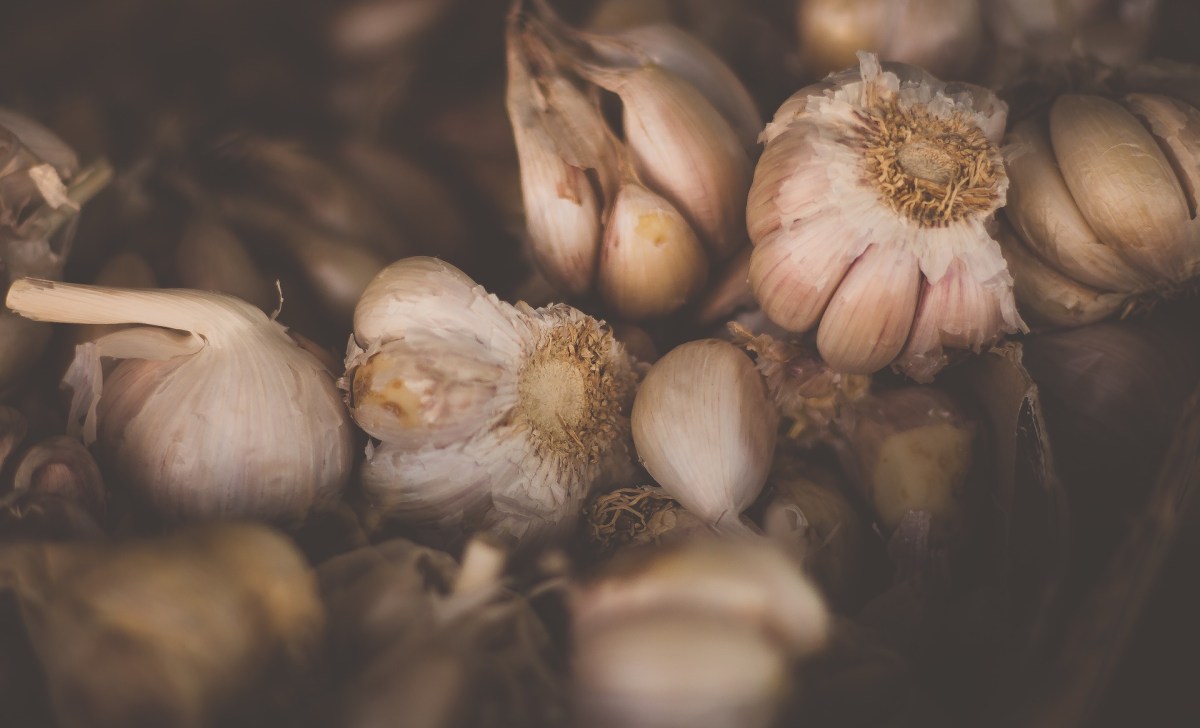
Can dogs eat garlic? Is garlic toxic or safe for dogs? Scientific evidence of garlic for dog's health, canine diet, nutrition, worming / (C) Perfect cocker spaniel, breed and puppy guide book, puppy tips, canine nutritionist, dog diet, cocker spaniel grooming / Natalia Ashton

Can my dog eat… garlic?

You are walking down the street in the evening or just about to approach an Italian restaurant and suddenly there is a delicious aroma hitting your nostrils and making your hungry instantly. When somebody cooks with garlic, the rest of the world is there to dream of roasted chicken, lamb, pasta, pizza or garlic bread… Because nobody can resist it. And hardly any kitchen can be complete without a few fat bulbs, bursting with goodness beneath the delicate tissue-paper like skin…

Garlic is so good for us, not only because it’s full of vitamins and minerals, but because this humble allium vegetable is a mighty source of sulphur compounds known to be beneficial for our hearts, the immune, digestive and endocrine systems, supporting detoxification and reducing inflammation.

But CAN OUR DOGS EAT GARLIC?

The short answer is NO….

Especially if they are English cocker spaniels.

Even though you might have heard otherwise, garlic is toxic to dogs. It is true that it was used by the breeders back in the 19th and early 20th century, but purely due to the fact that conventional and reliable worming medicine did not exist at the time. As the years went by, the very same breeders not only documented the side-effects of the garlic, but also recommended replacing the natural remedies with veterinary products due to their reliability and lasting results.

Why is garlic unsuitable for dogs?

The vegetable contains sodium 2-propenyl thiosulfate, which is toxic for the canines because their bodies cannot digest it efficiently. The build-up of the substance leads to formation of Heinz bodies, or clumps of haemoglobin, causing the rupture of red blood cells, oxygen deficiency and life-threatening haemolytic anaemia (IMHA).

The dogs may develop the condition after eating a large quantity of garlic as a single dose or consuming small quantities on a regular basis over a period of time.  In most cases IMHA will seem to appear suddenly and be fatal.

Why is garlic still used for dogs?

The advocates of garlic recommend it as a natural worming treatment or simply because “it’s beneficial and safe”. The latter is accompanied by a study of beagles that were given garlic extract for 12 weeks and didn’t develop Heinz bodies.

However, it is worth bearing in mind that…

The group of scientists who conducted the research were employed by the manufacturer of the garlic extract used in experiments.

The researched themselves concluded that garlic quantity must be monitored to avoid harm.

The garlic extract provided sulphur-containing amino acids S-allylcysteine (SAC) and S-1-propenylcysteine (S1PC). It was not mentioned if the extract contained sodium 2-propenyl thiosulfate.

The typical lifespan of red blood cells is between 100 and 120 days, so 12 weeks weren’t long enough to fully examine the body’s reaction to the substance.

Beagles are not genetically predisposed to the condition and we do not know enough information of their age, gender or health status at the time of the study.

The statement on garlic safety also contradicts independent studies and records spanning 30 years, discussed in interviews, books, scientific articles (1, 2, 3), veterinary manuals and journals (4, 5, 6, 7, 8) lists of poisonous substances  for dogs (9, 10) and included in FEDIAF guidelines and  top 10 animal toxins by ASPCA.

Why some dogs don’t develop Heinz bodies or haemolytic anaemia?

It can be related to genetics, breed predisposition (and cockers are among the breeds predisposed to the disease), hereditary defects, dog’s health, medical history, gender, age, and nutritional status (for example, selenium deficiency can increase the risk).

What about the worming effects of garlic?

There were no English language based clinical studies to support the use of garlic as an effective anti-worming medicine for dogs. Only two limited clinical trials conducted in 1969 and 2011 and described in Veterinary Evidence paper partially focused on the use of garlic alongside other herbs and plants such as pumpkin seeds. The quantities of the garlic were not included. There was no information about dogs except the number of dogs used and the names of parasites they had. The studies did show that garlic temporarily reduce the eggs and larvae, but only in specific species of worms. It did not seem to have effect of adult worms or certain species of worms. The questionable efficiency also meant that dogs would have to receive garlic at least every 2 days because the parasite levels returned to pre-treatment volume within 48 hours once the garlic was discontinued.  This means that all dogs remained at risk of either suffering from worms or potentially building up thiosulphate levels and developing haemolytic anaemia.

Interestingly, one of the known pioneers of using garlic as a worming treatment for dogs does not even have a veterinary degree or any form of academic education in canine or small animal nutrition.

The bottom line is to leave the garlic out of your dog’s diet, especially if the dog is a cocker spaniel. It really is not worth the risk.

 

Photo credit: image by StockSnap from Pixabay

Simple way to keep dogs live longer, healthy and happy life / study on dogs obesity and lifespan / Perfect cocker spaniel / Dog blog, english cocker spaniel tips, advice, grooming, training / canine nutrition, dog diet, dog nutritionist uk / (C) Natalia Ashton

The most simple way to keep your dog live for longer

Some time ago I read a story about selective breeding and Pekinese dogs in ancient China. The Lion-like dogs were considered sacred and protected by the Manchu emperors who not only exclusively owned the dogs, but kept a watchful eye on their breeding quantities and qualities.

Thus the Pekinese were bred for both form and function ensuring that their exquisite beauty, intelligence and character would not be achieved by sacrificing their physical well-being.

As a result, even though the little dogs still had their short muzzles (known as brachycephaly), they were said to remain active and disease-free for their entire lives that often spanned a quarter of a century.

I sat there thinking how wonderful it would be to share 25 years of my life with my dogs. The life without disease or heartaches. Of course, it’s more of a dream than reality, but there are some realistic ways to ensure that our pups stay with us for longer. Including the most basic and straightforward one…

In 2019 Journal of Veterinary Medicine published a North American study that looked into the lifespan of 12 breeders of pet dogs aged between 6.5 and 8.5 years old and identified as either “overweight” or “normal” based on the Body Conditioning Chart.

The results of the study showed that the overweight group of dogs had a shorter lifespan compared to the “normal” group of the same breed. The difference ranged between 6 months and 2.5 years, and the smaller breeds seemed to be more affected than larger ones.

The study had its flaws because the data was collected from a great number of vets working in 900 veterinary hospitals across the country, there was no specified medical history that could have affected dog’s health, the comparison chart for the maximum age was based on generic breed information, and all dogs used for the study were neutered.

Having said that, the fact is that the dogs who carried extra kilos were at higher risk of earlier death than their slimmer counterparts is obvious.

For us, as dog parents, it means one simple rule – keeping our spaniels fit and lean means longer life together!

Cockers are prone to weight gain, so it is vital to monitor their diet (treats included!) and exercise to suit their age and physical requirements, keep them well to avoid the need for certain medications that can contribute to weight-gain as a side-effect, reconsider routine neutering, and most definitely consult a vet if you suspect any underlying conditions that may get your dog put on pounds. And if your spaniel already looks a little chubby, help them lose the pounds for good.

It really is such a small effort for achieving something pretty wonderful. And who knows maybe there will come a day when we and the pooches really do get to share a quarter of a century together again…

How much water should a dog cocker spaniel drink? Why my puppy drinks so much water? Can drinking water cause problems? When dogs need more water? Diet & nutrition tips and advice for English cocker spaniels dogs by pet nutrition coach / canine nutritionist / Perfect cocker spaniel dog blog, puppy tips, diet, health, grooming (C) Natalia Ashton

How much water should a spaniel drink?

Do you ever wonder if your cocker spaniel drinks too much water? Or, perhaps, not enough? This is especially curious when you have a little puppy  because they seem to drink a lot, often turning each “session” into a splash and a dip, too.

We don’t tend to think about it, but water is the most important nutrient for dogs. They can survive without food to the point of losing half of body fat and over 50% of body’s protein storage. Yet loosing 10% of water will be fatal.

Water fills every cell of the body and makes up 80% of lean body mass. It is in the blood, in the cells, in every tissue and organ supporting biological function from transport of the nutrients, toxins removal, temperature control and homeostasis to giving shape to the body.

Dogs will naturally lose water through urine, faeces, breathing, panting and sweating (through the paws). Water will also be used to support body chemistry.

How much water does a dog need a day?

There are a few formulas to establish this amount. The basic one is dog’s body weight, kg x 50 (or 60) ml. However the resulting number should only be used as a general reference.

Why some dogs need more water?

The actual need for water will depend on many factors. Puppies and junior dogs usually need more than adults. Pregnant and lactating bitches would drink more, too. Hot weather, changes in body temperature, body composition, stress, vomiting, diarrhoea, illness, certain medications, amount of exercise and type of food will also have an effect on daily water requirements.

Why do puppies drink so much water?

The need for water depends on the amount of lean mass, volume of food needed per kilo of body weight, and what is known as surface area per unit of body weight because the latter determines the speed of evaporation. Puppies eat more yet their surface area per kilo of body weight is larger compared to adult dogs. They are also going through a growing stage when the body need extra fluids. Plus, puppies often have slightly higher body temperature than adults, which also means that the body may need more water to maintain homeostasis  or the balance between chemical and physical states.

Can a dog drink too much?

Yes. This can happen to some avid swimmers who tend to fetch balls and sticks in the water, and dogs who like to play with water hose or sprinkles. If they swallow too much water, it can affect electrolyte levels (the balance of sodium and potassium in the body when sodium levels become low) and cause hyponatremia or water intoxication. The condition can affect several organs and body system, cause brain swelling and be fatal if left untreated. If the dog is affected, he becomes lethargic, looks weak, confused and out of balance, develops gazed look, has vomiting and diarrhoea, and suffers from seizures leading to coma.

How to make sure the dog drinks enough?

Keep an eye on his water bowl. Make sure that your spaniel has an access to fresh cool water at all times. Change it daily and top up if necessary. And always carry supply of water if you go for a walk on a hot day.