Important rules, law, regulations every dog owner needs to know in the UK / Animal welfare act, lucys law, five freedoms for animals, nuisance barking / Perfect cocker spaniel dog blog (C) Natalia Ashton

Playing by the rules

Once upon a time we lived in a little development inhabited by lovely people. Except one. Not that he hated dogs per se, I think he simply needed anger management classes. He occasionally barked at people and eventually got to yell at me, too. On that occasion Coop spotted a friend of mine he was fond of… So the boy expressed his undying love through woofing.

She didn’t mind, I wasn’t insanely happy about it, but the sun was shining and we were about to have lunch, so a little noise was as ordinary as the life itself. The pup turned the sound off as soon as we greeted the girl and started a conversation.

Sadly, we got interrupted by a screaming man running towards me, cursing and saying how much he wished both my dog and I were dead. To his disappointment it wasn’t the case, so he proceeded to threaten me with reporting us to the council.

Long story short, he didn’t. More over it turned out that the source of the noise he found annoying came from a different household entirely. As in “two streets away” kind of entirely.

Even tough it wasn’t our fault, I returned home shaking. The incident happened a few short months after we lost Oscar and I was still a recovering mess of heartache and tears. The prospect of somebody reporting Coop and potentially losing him was frightening.

So I got onto the council website and realised that the threats were completely senseless. Soon after we moved away leaving all the negativity behind.

However, this particular event made me really look into dog laws in the UK. There aren’t many (hey, result – this blog post is not going to take a lifetime to read!), but I think it is very important to know and follow them.

FIVE FREEDOMS or the Animal Welfare Law

All UK dog parents are legally obliged to ensure that they take care of their dog’s welfare needs.

Often refereed to as “Five Freedoms” these are based on 2006 Animal Welfare Act (Section 9) and include:

… providing a suitable environment

… feeding wholesome and appropriate diet

… ensuring that the dog is able to exhibit normal behaviour patterns

… housing the dog with, or apart from, other animals

… ensuring that the is free from pain, injury, disease, and suffering

Dog owners who fail these can be prosecuted and face either a prison sentence for up to 6 months or a fine of up to £20000.

ANIMAL CRUELTY

A failure to meet the above rules or intentionally hurting a dog can lead to prosecution for up to 6 months or a fine of up to £20000.

DOG IDENTIFICATION

Under the Control of Dogs Order 1992, all dogs visiting public places must wear a collar with a name and address of the owner (plus a non-mandatory telephone number), either on the collar or on an attached tag.

The rule does not apply to dogs registered with the Guide Dogs for the Blind Association; any dogs used in emergency rescue work or on official duties by a member of HM Armed Forces, HM Customs and Excise or the police; any dog while being used for driving or tending cattle or sheep; any dog used for the capture or destruction of vermin; any dog used for sporting purposes; any pack of hounds.

MICROCHIPPING IS MANDATORY

It is a legal requirement for all dog owners to have their dogs microchipped and registered with a database by the time the puppies are eight weeks of age. The breeders need to register themselves as the first puppy keepers. It is new owners responsibility to update the database information once they collected the puppy from the breeder.

TAIL DOCKING

The practice of tail docking was seised in 2007 under the Docking of Working Dogs Tails (England) Regulations 2007 and Docking of Working Dogs Tails (Wales) Regulations 2007. These come with exceptions for working dogs (which must be proven) and certain breeds. The tail can also be docked for medical reason. However, show cocker spaniels born in the UK always keep their tails as nature intended.

THE USE OF SHOCK COLLARS & OTHER AVERSIVE DEVICES

At the moment these are technically allowed in England, but are banned in Wales. Even though the agreement to ban them in England hasn’t been achieved yet despite numerous campaigns and efforts, it goes without saying that these devices cause nothing but pain and fear in dogs and as such should be seeing as animal cruelty.

CONTROLLING THE DOG IN PUBLIC PLACES

It is our responsibility as dog parents to ensure that the dog behaves in public including public places, your own house and garden, your neighbours house or garden or any private places that do not belong to you, and does not create a situation when he either injures a person or makes somebody worried that he might injure them.

Additionally, the dog should be prevented from attacking somebody’s animal (dog or otherwise) or making the owner of an animal thing they could be injured if they tried to stop your dog from attacking their animal.

The penalty is either an unlimited fine or imprisonment for up to 6 months or both. An injury to an assistance dog may increase the sentence to up to 3 years with an additional fine.

If the other side and parties believe that the dog is dangerously out of control, he may be destroyed and you may not be allowed to ever have a dog in the future.

If the dog injured a person his owner may be sent to prison for up to 5 years, face a fine or both. Using the dog to deliberately injure somebody can be charged with “malicious wounding”.

If the dog kills somebody, his owner will be sentenced for up to 14 years or get an unlimited fine.

If the dog causes damage to any form of property that does not belong to you, you may be liable to cover the costs under the Animals Act 1971. Most pet insurances have this clause included.

Additionally, under the Highway Code the dogs must not be let out on the road on his own. All dogs must be kept on a short lead when walking on the pavement, road or path shared with cyclists or horse riders.

DOGS & LIVESTOCK

It is forbidden for the dog to worry or chase livestock, flush game birds, or disturb wild life on one’s land. If the farmer believes that your dog is creating a stressful situation or can potentially injure his animals, he is allowed to kill the dog.

However, the laws that protect public rights of way including public footpath and bridleways, do not impose any rules about how dog owners should behave whilst on the path/bridleway. There is also no legal requirement for dogs to be on a lead or under control in sensitive situations or near the live stock. But the rules only protect the walkers if the dog owners and their dogs stick to the legally approved path or route. If the dog runs into the field or land off the public path, he can fall into the Dogs and Livestock part of the Dogs in Public Places Law.

The dogs should also be kept on a lead of no more than 2m in length when near the live stock, farm animals or ground-nesting birds between 1 March and 31 July each year. There is no definition to the distance between the dog and the livestock and there is no criminal offence for those dog owners who break the rules, however, those owners may be temporarily denied the right to walk in these areas.

DOG FOULING

Under the Dogs (Fouling on Land) Act 1996 and The Clean Neighbourhoods & Environment Act 2005 any person in charge of a dog in public areas must clean up after his pet. A failure to do so can make the person guilty of offence of subject to a fine.

The Act does not apply to land used for agriculture, woodlands, marshland, moor or heath, urban common land, and carriage way where the speed limit is over 40 miles per hour.

Even though there is no law to cover this, it is important that anyone cleans after their dog when walking in the country side and farmland, especially during the lambing and cattling season. The dog faeces contain certain neosporosis and sarcocytosis that can lead to abortions in cattle and death in sheep if the animals come in contact with faeces though grass, feed, water or bedding.

Some councils can now issue a fine of up to £100 if they can prove that you did not carry spare poo bags when walking your dog even if you have one in your hand but it’s already filled with poop. No spare bag – you get fined. The rule only applies to certain areas. If in doubt, check your local council’s website for additional information.

THE ROYAL CONNECTION

Even though you are extremely unlikely to meet Lupo, the cocker, or any other Royal pooch when out and about, it is considered an offence for your own cocker to consummate a relationship with a pet from the royal house unless you have their permission to do so. If your dog has a secret affair without notifying you first, you will be fined.

DOGS IN CARS

Under the Highway Code if you travel with a dog in your car, he must not be nuisance or distraction to the driver in any way during the journey.

The dog should be suitable restrained with a seat belt harness, pet carrier, crate or dog guard or any other appropriate way whilst you are driving to prevent injuries to themselves, the driver or passengers, if the car stops quickly.

Having an unrestrained dog in the vehicle may result in a fine of up to £2500.

THE RULES OF BARKING

Dogs bark because they need to communicate but don’t speak human. I bet they’d speak English to express their thoughts if they could, but alas, woofing is the only option.

Most barking is considered natural and not a Statutory Nuisance, so there is no need to be concerned unless the barking “unreasonably and sensationally interfere with the use or enjoyment of a home or other premises or injure health or become likely to injure health” meaning that…

… the barking continues for long periods of time;

… the barking is frequent and excessive;

… the dogs bark very early in the morning or late at night, i.e. between 23:00 and 7:00

The dog and his owner can be reported to the council under Environmental Protection Act 1990, however the confirmation process can take weeks and months to collect the evidence including a barking diary.

BURING YOUR DOG

It’s a heartbreaking topic to mention, but if you are in the UK, you cannot lay your dog to rest anyone but your own home. The house and land must be owned by you, not rented. You also need to have a confirmation from your vet proving that your dog is not hazardous to human health.

LUCY’S LAW

Lucy’s Law was introduced in April 2020 to ban third party puppy sales, such as puppy farms and puppy shops, in England. It means that anyone looking for a puppy should only get one from a reputable breeder who is able to show the puppies interacting with their mum at their place of birth.

The breeder must obtain and be able to show a breeding license from the local council. A failure to do so may lead to an unlimited fine or prison sentence. It is always best to walk away and look some place else if something does not feel right.

This law is not enforced in Wales.


Photo credit: image by Gerd Altmann from Pixabay

Are dried, raw and dehydrated treats safe and good for my dog / Bully sticks, pizzles, rabbit ears, pigs ears, rawhide treats, liver treats, fish skins for puppies / Nutrition advice for dog owners / How to choose dog treats safely? / Dangers of raw and dehydrated dog chews / Fanconi syndrome in dogs / Perfect cocker spaniel (C) dog blog, cocker spaniel advice, health tips, grooming tips, puppy training, diet, questions / Natalia Ashton

Q&A | Can I give my puppy dried & dehydrated treats?

Once upon a time, when Cooper was a little puppy, we took him for a walk in the wild where the boy met another cocker spaniel. And as all pup parents we stop and chatted about the way our pups are raised, groomed and fed. At one point the other pup’s dad mentioned that he swears by natural treats…. freshly shot pigeons, rabbit ears covered in fur, raw bones, dried chicken legs… the list went on. At the time I never heard of those.

I did a bit of googling upon return, found a few things, but never felt convinced enough to give them to my puppy.

A few years on, and there is a huge array of treats available around to keep the dogs happy.

But are they actually safe?

The first thing you need to bear in mind is that very few of those treats would be suitable for a cocker spaniel puppy. The only exception is sweet potato but even those need to be looked at with caution because, as it happened last year, they can arrive covered in mould due to poor manufacturing or storage.

Any dehydrated body parts may suit an adult dog with a robust digestive system, but they contain too much protein (pigs ears, for example, contain 73%) for a little puppy and thus can increase the risk digestive upsets as well as skeletal problems in the future.

Additionally, not every company can guarantee complete product safety, so the chews and treats may be contaminated with bacteria, toxins (as a by-product of bacteria lifecycle or from the animal source), pathogens or chemical residue (unless you can absolutely guarantee that the animal has never been treated with antibiotics or fed a pesticide-free diet, just to give you an idea)

For example, when a study published in Canadian Veterinary Journal examined 26 random bully sticks, all 26 were found to be contaminated with bacteria including Clostridium difficile, MRSA, and E. coli. It followed the 2019 case when FDA issues a recall for all pig ear treats due to salmonella outbreak.

An adult dog may show no symptoms and have no side-effects, but the puppy’s gut defences are still weak and can be affected.

There is also a possibility that the asymptomatic dog will shed salmonella for about 7 days, potentially passing it onto his human family.

Some animal body parts can contain high levels of specific minerals and vitamins, which can potentially cause vitamin and mineral imbalance in the dog’s body.

Others, like pig ears, are naturally high in fat and can lead to weight gain, diarrhoea and even increased risk of pancreatitis.

Certain body organs can naturally contain hormones. If a dog regularly consumes such treats, his own endocrine system can be affected.

Treats add calories. It is known that a typical 20cm raw hide chew can contain as much as 100 calories, which is roughly 15-20% of your dog’s daily requirement. Considering that all treats should fall below 10%, anything on top can lead to weight gain and obesity. Reducing the amount of food your dog eats for a sake of giving him a chew can create a deficit or excess of major nutrients and cause problems.

Not every chew is safe. Some can splinter, others can cause blockages or perforations of the gut.

Antlers, hoves, horns and bones may be extremely popular among dogs, but they are also  a major concern among vets because these can cause jaw dislocation and broken teeth, especially in dogs who really do love to chew hard.

Fish skins are suitable for most dogs, but not puppies under 4 months of age.

Liver treats appeal to all dogs, but they are incredibly rich in vitamin A and can cause toxicity if used frequently or generously. Liver is also a detoxifying organ, so any residue from those toxins can end up in your dog’s body.

Dehydrated meats often referred to as jerky can cause Fanconi syndrome. The illness causes kidney damage, can become chronic and even be potentially life-threatening. The symptoms of Faconi syndrome are not easy to spot and usually include changes in urination and drinking habits and can mimic the ones of diabetes, kidney disease and urinary tract infection. It is impossible to say which treats may lead to problems – so far it has been established that the issue does not relate to a particular manufacturer or a country of origin, but has to do with a certain substance in the treats. And the substance is yet to be identified.

So what can you do if you want to treat your dog safely?

Choose a trusted UK-based (or EU-based) company that  follows strict guidelines for product safety, happy to provide you with additional details and inform of any food recalls should the worst happen.

All reputable UK pet food companies should be registered with PFMA

All UK companies that produce any treats made from by-products must be approved by APHA. Depending on their set-up, they are often required to obtain a licence from a local authority, too.

Any pet food manufacturer should have at least one nutritionist who holds a veterinary degree and/or is trained in small animal clinical nutrition.

Check the packaging label for any age restriction. If you can’t find any, contact the company.

Always check the treats for signs of mould and odd smells (even though some can be a little smelly, but they should not stink)

Give these chews once a week at most, not on a daily basis.

Always supervise your dog when he is busy chewing.

If in doubt, bin – don’t feed.

Make your own treats or indulge your dog’s need to chew by giving him crunchy slices of carrots and apples.

If your dog has diagnosed health conditions, is genetically predisposed to such illnesses as pancreatitis, or requires a special diet, always consult your vet before you use these (or any) treats.


Photo credit: image by Mikhail Dmitriev for 123rf.com

What is dog's reactivity / Hyper-reactivity in dogs, barking, lunging, biting dogs / Leash reactivity, barrier frustration / Perfect cocker spaniel Dog blog

Re-activating happiness | What is reactivity, anyway?

All good things take time, so I only hope that the second chapter for my “re-activating happiness” diary is worth the wait.

Today I wanted to talk about reactivity itself because most people are simply unaware of it and many tend to mistake their dog’s reaction for aggression, which can in turn lead to some terrible outcomes.

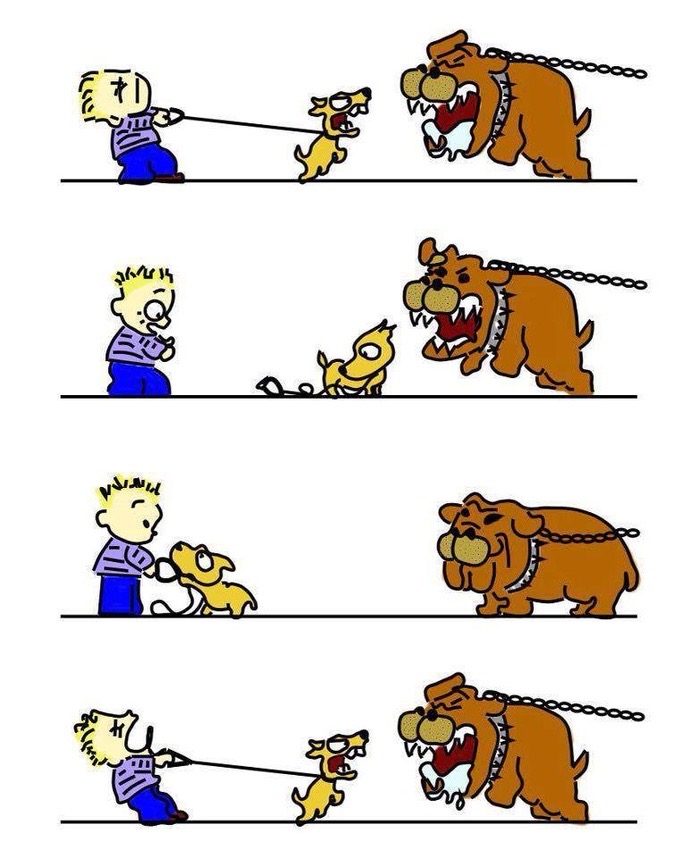
Take the cartoon above. A lot of people find it funny, but if you look closely, you can see a typical example of two leash-reactive dogs. And suddenly it’s not so entertaining anymore…

So what is reactivity?

Correctly referred to as  “hyper-reactivity”, it is a dog’s over-reaction to something or someone around him because he is unable to perceive it as safe and ordinary, or may doubt his ability to predict and control it. Objects, strangers, kids, bicycles, men in glasses, men in hats, postmen, vets, small dogs, black dogs, giant dogs and spotty dogs, dogs walking towards you or puppies bouncing in your direction… The list goes on. So the dog hides, or runs away (flee), or growls, or barks (fight)… He may pull on a lead (lead reactivity)… Or jump at a fence (barrier frustration)… He may even lunge and try to bite… Oddly to their parents, most of these dogs become soft and cuddly when in a safety of their own home, walking down a familiar empty street or running free in a deserted field.

But because of their outbursts these pups get labelled as “shy” or “noisy” or, worse, “aggressive” even though all they are trying to say is that they are simply scared of something… and do everything they can to prevent the scary scenario from happening again.

Dog's body language / ladder of aggression by BSAVA / reactivity in dogs explained / Perfect cocker spaniel, dog blog & reactivity diary of living with reactive dog

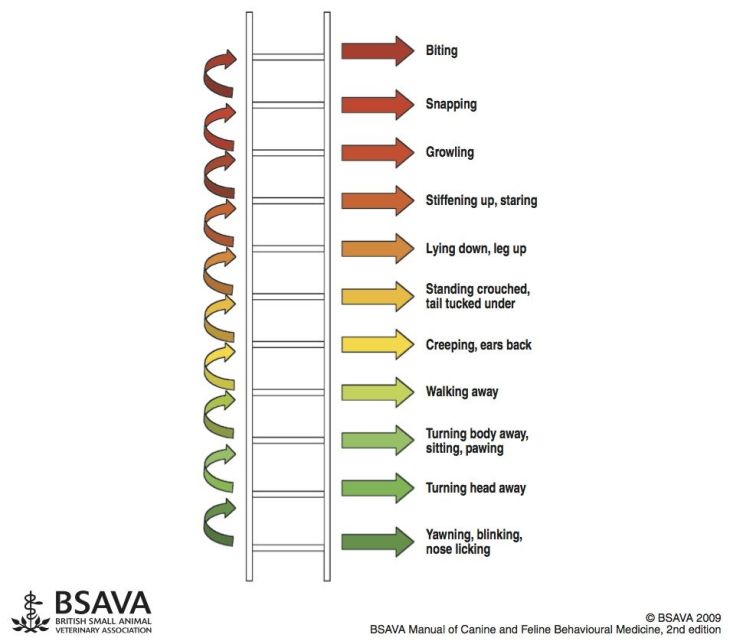
At first, they will use the subtle signs to explain their emotions. They may lick their lips or nose, turn or walk away from the “scary thing”… If this does not work, the body language will become more obvious. The dog will get lower to the ground, tuck the tail under his tummy, or freeze. In the animal world this would be enough to say “Hey, I am not comfortable, I am scared, I want you to go away, and I don’t want to fight…” Because dogs, with a few breed-related exceptions, really are not the fighters or killing machines. Even if they snap, they will never bite to hurt.

However, if the dog cannot avoid the uncomfortable situation (say, he is on a lead, the scary thing is there or approaching, or there is a fence between him and the scary stranger) or make the “object” go away, he will end up growing, snapping and even biting, as the last and most definitely, not his preferred option. He will be acting out of fear and frustration of being misunderstood, not because he is a hopelessly aggressive beast.

If the dog’s message gets lost in translation over and over again, the may eventually learn that the “building blocks” of calming body language are completely worthless and the best way to get rid of the “scary thing” is to bark, snap or bite without warning. This natural reaction soon becomes a learnt habit (also referred to as conditioned response or conditioned behaviour), so next time the dog will skip the entire body language routine and simply use the tactic that worked before – the bark, the grown or the snap.

Worse, the pooch can also end up in a constant state of stress and anxiety, expecting the “scary event” to happen at any point. As his body tries to cope with the emotional outcome of stress, it engages other systems, alters hormonal and nervous responses, uses up essential nutrients, and eventually becomes unwell physically and psychologically. The dog transforms into uncontrollable, hyperactive and anxious animal suffering from phobias that may expand from the initial object of fear to many other.

The latter is the reason why it is so important to be aware of the hyper-reactivity and either prevent from happening or helping your dog to overcome the fear if he does feel scared and has to act up to feel safe.

What can lead to hyper-reactivity?

It can be a traumatic event. It can be stress that leads to altered hormonal and brain responses. Lack of proper socialisation can be directly related to the dog’s perception of life. Pain and fear of pain can make a dog hyper-reactive, too. The over-reaction can also be caused by our own emotional state that becomes mirrored by our dogs.

At this point it is important to mention that some dogs can become reactive or prone to reactivity due to their hereditary traits or any form of emotional stress experienced by their mother during pregnancy or after the birth of the litter. Such puppies can show first signs of reactivity even before they open their eyes.

One of the most recent studies published in the January 2020 issue of Helioyn Journal also looked into microbiome (or gut flora) to discover that reactive dogs seem to have different types of bacteria compared to fearful dogs. “Different behavioral phenotypes in dogs may be associated with peculiar gut microbiome layouts, suggesting possible connections between the gut microbiome and the central nervous system,” the researches concluded.

Ageing can also be the time when a dog may suddenly become reactive, partially due to his declining health, possible aches, pains, and partially because ageing causes irreversible brain changes. Contrary to popular believe, the loss of sight or hearing does not lead to reactivity-related aggression.

The traumatic event at any point of dog’s life can also have a negative effect on his emotional state and ability to cope with any further events, especially if they happen at the same location or caused by the original stimulus. Fearful events during sensitive period of puppyhood at 8-10 weeks and “the fear period” that occurs at around 8 months of age, can make the most impact on the young dog and his life-long emotions. Having said that, even through the memory of the event can become permanent, it may be restrained and prevented from re-occuring though coaching and counter-conditioning.

Prolonged, or chronic, stress, on the other hand, can lead to permanent degenerative changes within the brain areas and alter dog’s ability to cope with any further fear or stress however minor.

What you need to take away from this is that reactivity, regardless of its extent, does not define your dog. It does not make your dog “aggressive”, “violent”, “naughty” or “lost cause”. It does not require castration as a “fix”.

All it needs is an understanding, patience and a carefully constructed plan that often involves counter-conditioning, desensitisation and games to help the dog realise that many things he is so afraid of are actually mundane and not worth his time whatsoever.

When the dog barks and growls, he needs protection and care from you, the person he loves and trusts the most. And the good things will happen… The happiness, and calmness and all that jazz. They’ll take time, but nothing is impossible.