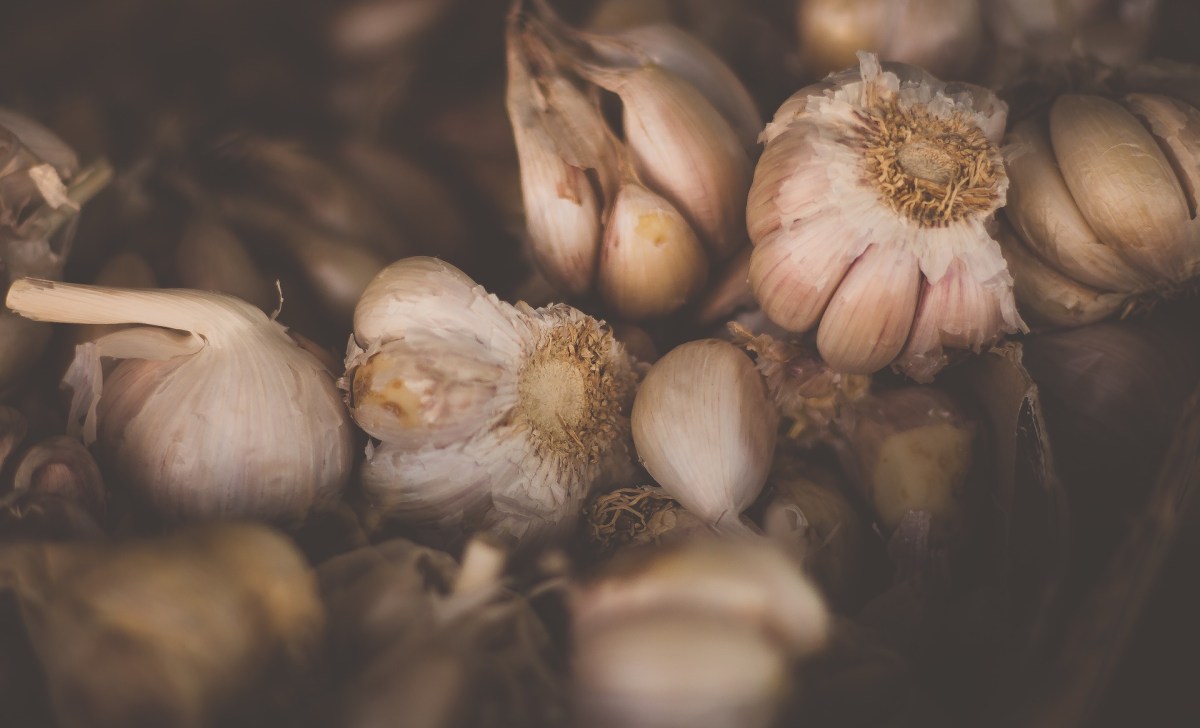
You are walking down the street in the evening or just about to approach an Italian restaurant and suddenly there is a delicious aroma hitting your nostrils and making your hungry instantly. When somebody cooks with garlic, the rest of the world is there to dream of roasted chicken, lamb, pasta, pizza or garlic bread… Because nobody can resist it. And hardly any kitchen can be complete without a few fat bulbs, bursting with goodness beneath the delicate tissue-paper like skin…
Garlic is so good for us, not only because it’s full of vitamins and minerals, but because this humble allium vegetable is a mighty source of sulphur compounds known to be beneficial for our hearts, the immune, digestive and endocrine systems, supporting detoxification and reducing inflammation.
But CAN OUR DOGS EAT GARLIC?
The short answer is NO….
Especially if they are English cocker spaniels.
Even though you might have heard otherwise, garlic is toxic to dogs. It is true that it was used by the breeders back in the 19th and early 20th century, but purely due to the fact that conventional and reliable worming medicine did not exist at the time. As the years went by, the very same breeders not only documented the side-effects of the garlic, but also recommended replacing the natural remedies with veterinary products due to their reliability and lasting results.
Why is garlic unsuitable for dogs?
The vegetable contains sodium 2-propenyl thiosulfate, which is toxic for the canines because their bodies cannot digest it efficiently. The build-up of the substance leads to formation of Heinz bodies, or clumps of haemoglobin, causing the rupture of red blood cells, oxygen deficiency and life-threatening haemolytic anaemia (IMHA).
The dogs may develop the condition after eating a large quantity of garlic as a single dose or consuming small quantities on a regular basis over a period of time. In most cases IMHA will seem to appear suddenly and be fatal.
Why is garlic still used for dogs?
The advocates of garlic recommend it as a natural worming treatment or simply because “it’s beneficial and safe”. The latter is accompanied by a study of beagles that were given garlic extract for 12 weeks and didn’t develop Heinz bodies.
However, it is worth bearing in mind that…
The group of scientists who conducted the research were employed by the manufacturer of the garlic extract used in experiments.
The researched themselves concluded that garlic quantity must be monitored to avoid harm.
The garlic extract provided sulphur-containing amino acids S-allylcysteine (SAC) and S-1-propenylcysteine (S1PC). It was not mentioned if the extract contained sodium 2-propenyl thiosulfate.
The typical lifespan of red blood cells is between 100 and 120 days, so 12 weeks weren’t long enough to fully examine the body’s reaction to the substance.
Beagles are not genetically predisposed to the condition and we do not know enough information of their age, gender or health status at the time of the study.
The statement on garlic safety also contradicts independent studies and records spanning 30 years, discussed in interviews, books, scientific articles (1, 2, 3), veterinary manuals and journals (4, 5, 6, 7, 8) lists of poisonous substances for dogs (9, 10) and included in FEDIAF guidelines and top 10 animal toxins by ASPCA.
Why some dogs don’t develop Heinz bodies or haemolytic anaemia?
It can be related to genetics, breed predisposition (and cockers are among the breeds predisposed to the disease), hereditary defects, dog’s health, medical history, gender, age, and nutritional status (for example, selenium deficiency can increase the risk).
What about the worming effects of garlic?
There were no English language based clinical studies to support the use of garlic as an effective anti-worming medicine for dogs. Only two limited clinical trials conducted in 1969 and 2011 and described in Veterinary Evidence paper partially focused on the use of garlic alongside other herbs and plants such as pumpkin seeds. The quantities of the garlic were not included. There was no information about dogs except the number of dogs used and the names of parasites they had. The studies did show that garlic temporarily reduce the eggs and larvae, but only in specific species of worms. It did not seem to have effect of adult worms or certain species of worms. The questionable efficiency also meant that dogs would have to receive garlic at least every 2 days because the parasite levels returned to pre-treatment volume within 48 hours once the garlic was discontinued. This means that all dogs remained at risk of either suffering from worms or potentially building up thiosulphate levels and developing haemolytic anaemia.
Interestingly, one of the known pioneers of using garlic as a worming treatment for dogs does not even have a veterinary degree or any form of academic education in canine or small animal nutrition.
The bottom line is to leave the garlic out of your dog’s diet, especially if the dog is a cocker spaniel. It really is not worth the risk.
Photo credit: image by StockSnap from Pixabay


 PERFECT COCKER SPANIEL