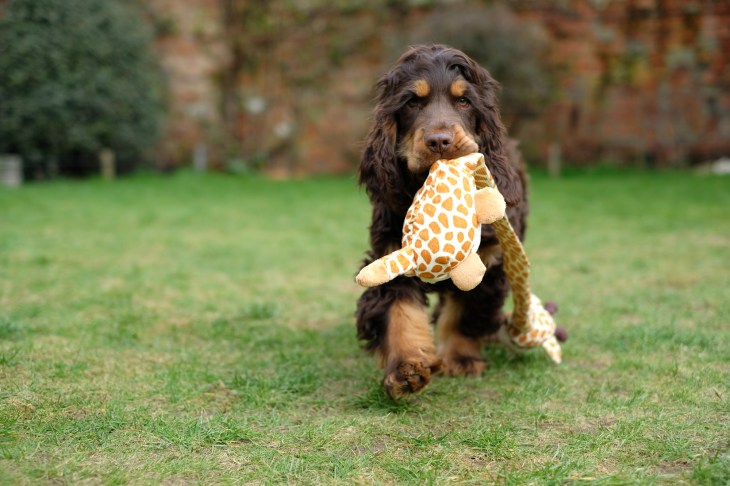
Oscar was a true cocker spaniel. He loved his food. Not as much as he loved us, but I suspect the food came second… Especially when it came to French bread.
How on Earth did Oscar figure out the delights of French culture? I am not sure… He grew up with a little crunchy crust of a classic English toast… And then, somehow, the English lad got the taste for one of the Parisian statements… The boy loved those crisp light baguettes. He always knew that we’d bring one on a saturday morning. And every time Oscar sat in the kitchen waiting patiently for us to cut off the end, took it carefully from our hands and then run, run fast, to the spot in front of the garden door…. To devour his “baguette magique” in the room with a view… This dog had more flair for joie de vivre than both of us combined.
I think it was probably the bread that made him put on a little weight. We didn’t notice at first. Ozzy was born deliciously chunky and his shape and glorious coat never really made him look anything but scrumptious.
But since “hips don’t lie” we had to do something about those extra kilos. He didn’t enjoy carrying them – and we hated seeing him uncomfortable. A few months later Oscar got back to his perfect shape. He never stopped loving or eating baguettes – we simply made sure to be careful with the quantities and frequency of the treat.
The whole “overweight” experience was something I’ve never really dealt with before. None of my dogs ever had issues. And after we helped Oscar to shed the pounds, I promised myself to never ever get into this situation again.
I kept my word. Both Coop and Fred have what would be classified as ideal body score.
Why does it matter to me so much? The most important thing to remember that any excess weight is not just a cosmetic imperfection. Trust me, I am a nutritionist after all.
The fat tissue is not simply sitting there like a cute cushion. It is actively producing hormones altering the ones circulating through the body and talking to different organs. As a result the excess fat can contribute to the development of inflammation and hormone-related cancers. In addition, the excess fat can lead to heart failure, high blood pressure, arthritis, diabetes, skin problems, breathing difficulties, inability to maintain healthy body temperature or deal with heat, and reduce your dog’s susceptibility to illness because the immune system will be suffering from all those hormonal changes. Even a small increase in weight can shorten the dog’s life expectancy, make it more difficult for him to recover post-surgery or even get through one, if I am honest
Allowing your dog to remain overweight or obese means that you are willingly shortening his life day by day – and make the quality of his life unbearable as the time passes.
According to the BVA’s statistics 46% of dogs in the UK were classified as either overweight or obese in 2017. By 2019 the figure went to 51% according to the PFMA report yet 68% of dog owners thoughts that their pet was completely normal with 67% not expressing any concerns even after being told that their dog needed to lose weight
As a cocker spaniel parent you need to be particularly aware of the issue because cockers are one of the breeds that can put weight quickly if their food intake and exercise aren’t carefully monitored. This is especially important during the puppy hood or if your dog has been neutered or getting older.
What factors can lead to excess weight or obesity in a dog?
Overfeeding. Too many treats, free-feeding, constant swapping of different dog foods, unbalanced diet containing too much protein, fat or carbohydrates, mixing up brands and formulas, adding a few titbits to your dogs dinner “to make it nicer”, creating your own meals from scratch without consulting a canine nutritionist, letting your dog lick a bowl or plate after you finished cooking or eating dinner… All these factors are the reasons why the dogs can put on weight.
Any extra bite, any insignificant treat, anything that is given to your dog in addition to his daily food, comes with calories. And in case of dogs, these calories can add on incredibly fast.
A thin 25g slice of ham may seem like nothing to you, yet add 3-5% of your dog’s daily calorie intake in one go. Cheddar is widely recommended as a training treat, yet 25g contain 100kcal, which is about 15% (!) of a daily calorie requirement for an average cocker. A 40g slice of bread also contains 100kcal. An innocent looking digestive will add 70kcal or about 10% of your dogs daily energy needs… The grocery list goes on… To this add a couple of dog biscuits to the treat menu and voila – we have a problem.
The worst problem is that people do not really think about it until the dog already has a problem. And even then many will continue the treats because they associate them with love.
Please be honest with yourself. If you feed your dog with table scraps or tend to be generous with treats, you need to change your mind set right now.
Lack of exercise. A cocker needs an hour of exercise every day – and any dog should be walked for minimum 30 minutes a day to remain healthy. Yet the study published in 2019 showed that less than 50% of dog owners walked their dogs daily and even when they did, many dogs only got 20 minutes of walking per day!
A dog, especially a life-loving cocker, will walk with you whatever (or almost whatever) the weather! Please don’t deny them this joy – and learn to enjoy the activity together, rain or shine. It will be beneficial for both you and your wonderful companion, I promise.
Genetics. Cockers are one of the breeds prone to weight gain. This can differ from line to line and even location, but should always be taken into consideration.
Neutering. There isn’t enough evidence to say that all neutered dogs will automatically gain weight, however, the hormonal changes, especially the absence of oestrogen, that follow the op, will alter your dog’s metabolism and appetite, and increase the risk of weight gain as a result.
Health status. Thyroid disorders and diabetes are two of the hormone-related disorders that can cause excess body weight. Some prescription medication such as steroids can also lead to weight gain. Your vet should be able to talk you through the side-effects and how to avoid them.
Age. As the dog gets older his digestive system becomes less active and able to process the nutrients effectively and his endocrine system will be producing lower levels of hormones. Often the dogs will be getting less exercise, too.
How do you know if your spaniel needs to slim down?
Ask the vet. They are brilliant.
Identify if your dog is overweight or obese. The overweight dog has more body fat that is required for optimum health. The obesity means that the weight is seriously affecting the dog’s health and wellbeing.
Weight your dog. Not so much to use the number as the life sentence but more – to have a starting point. Just like with people, weight is a very individual thing for every individual dog. Yes, there is a specific “ideal weight” for a cocker spaniel , which is 12 – 14.5kg (26.5-32lbs) for a female cocker and 12.2 – 15.4kg (27.5-34lb) for a male, according to the veterinary manual and the breed standard. But some cockers can be a little bit smaller or bigger or into their exercise, which can shift the number slightly. The weight will also depends on your dogs age, genes and health status.
In his glory days Oscar handsomely weighed 14.5kg whereas Coop is about 13kg and Fred, my tiny pup, is barely 11 (but Fred really was the tiniest puppy of all times!)
Which takes me to the next point.
Use the body scoring chart. If you compare the shape of your dog to the chart it will show you straight away if your cocker is ideal, under or overweight. In fact, even British Veterinary Association advocates the use of body scoring over the scales. It is visual and can be done any time and anywhere.

You need to be able to feel the ribs and see the waist outline both from the top and the side. The dog must not look like a barrel.
If your dog’s weight is 30% or more above the “ideal weight” and/or has a body score of 8 or 9, he is likely to be considered obese and require immediate attention and weight loss strategy.
Even if your dog does not fall into obese category, but his body score clearly puts him into the overweight category, act now.
What can you do to help your dog lose weight?
Be honest with yourself. Admit that your dog has a problem and it is your responsibility to improve the situation.
Keep a food diary for 3-7 days to help you record everything you dog eats on a daily basis. This can be an eye-opener.
Weigh your dog and establish his body score. Keep the record of it. Weight your dog every 2-3 weeks to see any changes. Aim for 0.5-2% loss of initial body weight per week.
You can even take a photo of your spaniel once a week and store it in your phone’s favourites. Having visuals is one of the most powerful tools.
Be mindful when feeding your dog. Stop giving your dogs any left overs, bits of your food or dog treats. If you absolutely have to give your dog a treat, choose a thin slice of carrot and limit them to 2-4 a day max. You can create a treat container measuring precise quantities of carrot pieces a day. This step alone, especially when combined with moderate physical activities, can be enough to see weight loss.
Weigh your dog’s current food. Every food manufacture has a guide on a packet that shows you how much your dog should eat when he needs to lose weight, remain at his current weight or gain a little. If you unsure, ask your vet and contact the nutrition team of the pet food brand. They will be more than happy to help you.
Reducing the amount of your dog’s favourite kibble or wet food by 25% can be less stressful for both of you than replacing his entire menu with some low-fat formula that may dogs find utterly unappetising. Always discuss the reduction amount with your vet. You may need to do it gradually or not at all – if the treats are to blame for your dog’s weight.
Feed at set times.
Be active. Take your cocker for a walk at least once a day. Bear in mind that many obese dogs will find it challenging to go from very little activity to a mile-long walk. Build up carefully and keep setting new challenges as your dog gets fitter. Always carry some water with you to help your dog stay hydrated. Remember the weight can make it difficult for them to regulate the body temperature effectively.
Work with the vet that give your support – not judgement. It is crucial to find a vet who is there to give you advice and encouragement – not to blame you for being a “bad dog owner”. The latter can be really disheartening for even the most determined parent. Life has its own rules and it is not always something we can fully control, so it is best to focus on the present and the future and see this weight loss journey with your cocker as a positive fun adventure – not a punishment. It will take time, but you will see the difference!
If you would like to learn more about nutrition for your English cocker spaniel, how to choose his foods and keep him healthy and fit, read the relevant chapters in my book, Perfect cocker spaniel, the complete breed and puppy guide.
Photo source: “Tell me this isn’t celery” (C) by Cartoon Comics for Shutterstock / Perfect cocker spaniel, the Dogs Body Condition Score Chart via WSAVA


 PERFECT COCKER SPANIEL