Style outfit ideas for dog walking in fashion / Spring edition / Camel outfit ideas / Cashmere jumper, leather trousers, puff jacket, suede leather bag / Perfect cocker spaniel / pet blog (C) Natalia Ashton

Fashion guide to walking your dog in style | Spring edition

I saw this on Facebook the other day…. “You used to look nice. Perhaps, enjoyed selecting a nice outfit to wear for your Saturday shop and coffees out. You don’t give a shit now. Once never seen out unless fully made up you will now be found wandering round your neighbourhood at 7 am on a Sunday morning in your pyjamas with your puff coat, carrying a bag of hot poo, swinging it gaily even, by way of a statement, so all your neighbours know you are a responsible dog owner. You will have clothing envy as you meet other dog owners, clearly in the game longer than you have been as they have managed to get dressed and comb their hair…”

And as funny as it sounds, it made me think about my journey as a dog mum… I’ve always tried to look nice. In fact, I promised myself that all my boys will have a mum they’d be proud of. Sometimes, usually past the puppy period when I’d be covered in mud and paw prints most of the time, I succeeded… But then there were times I didn’t feel particularly pretty.

However… as I work from home and my life revolves around my (very good looking) pups, I end up dressing up for dog walks mainly. Or for outings with dogs. And for meeting other dogs. Which basically means that I still like my clothes, but have to forgo the heels and extra special pieces, and instead choose practical clothes that would still pass the “beautiful” mark. Because if the clothes aren’t beautiful or feel cheap and tacky, sooner or later the feeling will transfer onto, or even under, the skin like a permanent tattoo… And if you’ve even experienced it, you know it’s not a good feeling. At all…

So… Blame it on the spring, sunshine, fashion week or new collections, but I’ve decided to play a little style game here and share some outfit ideas for dog mums. Because we may still have a bunch of poop bags in every pocket, but those pockets will be attached to the prettiest jackets, trousers and bags!

Also… on a “before we begin” kind of note… Do you like the featured photo? Because I will be using it for the entire series of my style posts.

The look below is for an early spring, so you can layer the pieces depending on the weather. If you aren’t sure about the colour of the trousers, they come in black, too.
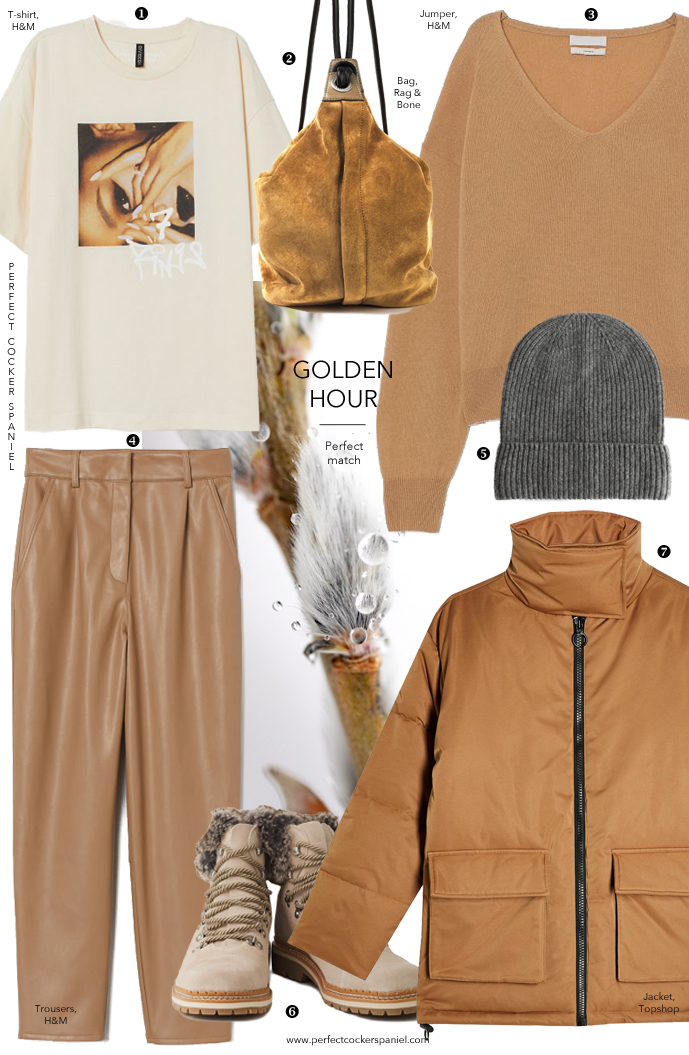
Style outfit ideas for dog walking in fashion / Spring edition / Camel outfit ideas / Cashmere jumper, leather trousers, puff jacket, suede leather bag / Perfect cocker spaniel / pet blog (C) Natalia Ashton

Shop: T-shirt | Trousers | Jumper | Boots | Hat | Jacket | Bag


Image credit: Karen Arnold from Pixabay

Can my dog eat almonds / safe and toxic foods for dogs / dogs nutrition / best diet for english cocker spaniel / diet tips for dogs / Perfect cocker spaniel blog (C)

Can my dog eat… almonds?

Since nutrition has always been one of my passions (and a job) I’ve decided to make it a permanent feature on Perfect cocker spaniel. Would be a shame not to since I hold qualifications in both human and canine nutrition, right?

I know I’ve already talked about the subject in the past discussing specific ingredients, avocados, cheese, and chocolate, talking about healthy dog treats, vegan diet, pancreatitis, and how to keep your dog’s weight under control, but it was always random. I’d like to change it and focus on the topic thoroughly.

“Can my dog eat…” posts will be a part of it. I’ll add them to the blog at least once a week and keep on going until we cover every edible and not-so-edible titbit.

Done with the prelude, lets talk about food!

Today we are focusing on ALMONDS in our dogs’ diet. Personally I love almonds very much: they are perfect on a go, full of vitamins, minerals, good oils and fibre, perfect for my skin and hormones, and make a fab substitute for flour.

But CAN OUR DOGS EAT ALMONDS?

The answer is NO.

Almonds contain cyanide compounds called cyanogenic glycosides, which is toxic to both dogs and humans. However, the sweet almonds sold in supermarkets and used in cooking contain very little quantities (16-32mg/kg), which makes them perfectly safe.

However, even though sweet almonds are not toxic to dogs, they may cause a few issues. First of all, almonds are not something that dogs can easily digest and can suffer from diarrhoea, vomiting, discomfort, bloating, gas, lack of appetite and lethargy. Almonds are high in fat, which can increase the risk of pancreatitis. If a dog swallows a whole almond, the nut may cause obstruction and be life-threatening.

Almonds may also be contaminated with aflatoxins (the toxic by-product produced by fungi that is often found in soil) that can cause damage to the nervous system, liver failure, or haemylytic anaemia, increase the risk of cancer and  be fatal to dogs.

In the other hand, bitter almonds (which can be found in some shops and online) provide 6.2mg of cyanide per almond, or about 1100mg/kg, are highly toxic to dogs and can be fatal if eaten.

Since, unlike humans, dogs don’t really rip any health benefits from almonds, it’s best to avoid them completely. Also remember to check ingredients labels on your dog’s food and treats to ensure they are almond-free.


Image credit:  Free-Photos from Pixabay

Latest studies to show that dogs may be able to count, use same area of the brain as humans, and have numerological skills / Perfect cocker spaniel dog blog about English cocker spaniels, puppy advice, tips, nutrition, grooming, research / (C) Natalia Ashton

Two treats are better than one and your dog is the one who is counting

“Make sure you give them two treats each,” I instructed my husband who was taking on the role of “the treat guy”… “Because they know, they always know…” I whispered.

I wasn’t making it up. There have been several studies peeking into our dog’s numerological abilities including the 2002 study suggesting that “dogs may have the rudimentary skill to count” and the 2009 research that compared dog’s intelligence to the one of a 2-year old human. And the latest findings published in December 2019 confirmed that dogs use the same number-responsive area of the brain as humans to “spontaneously process basic numerical quantities”.

The dogs used in the 2019 study were not trained, restrained or sedated to react to numbers or quantities yet they responded to the changing quantities of dots shown to them every time the numbers changed from constant.

According to the scientists “the results provide some of the strongest evidence yet that numerosity is a neural mechanism shared between dogs and humans that goes back as far as 80 million years”

And for us, dog parents, it means that our pups may, in fact, count their treats – and, as a result, achieve even better outcomes of reward-based training because they know there are still more yummy titbits to come.


Image credit: Gerd Altmann from Pixabay